The right irrigation system for a Saudi garden is almost always drip irrigation for planting beds, properly zoned by plant water needs and adjusted seasonally, since this minimizes the evaporation loss that makes sprinklers far less efficient in this climate.
Of every decision that shapes how well a Saudi garden performs, irrigation design carries the most weight — and gets the least attention. This guide covers everything from system types and sizing through the most common failure points and what irrigation genuinely costs, so you can make an informed decision whether you’re installing new or troubleshooting an existing system.
Why Irrigation Design Deserves More Attention Than It Usually Gets
Irrigation is the single most consequential design decision in a Saudi garden, more so than plant selection or hardscape, because even the right plants fail under the wrong watering approach — and the wrong system quietly wastes water and money for years before anyone traces the problem back to its source. Despite this, irrigation often gets treated as an afterthought, installed quickly and left unchanged for years regardless of seasonal needs or how the garden itself evolves.
This guide covers what a genuinely well-designed irrigation system looks like in Riyadh and Jeddah specifically, from system types through sizing, common failure points, and what separates professional installation from a generic DIY setup.
The Main Types of Irrigation Systems
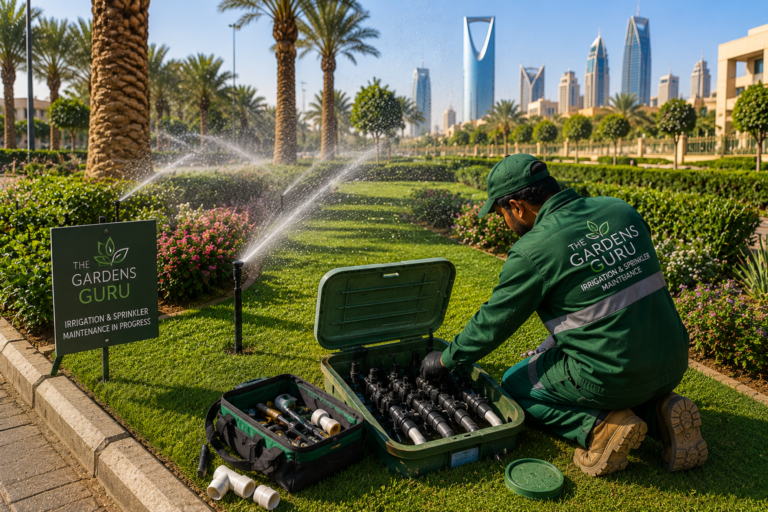
Three system types cover most residential irrigation needs. Drip irrigation delivers water directly to the root zone through a network of tubing and emitters, minimizing evaporation loss — the standard choice for planting beds, trees, and shrubs in this climate. Sprinkler systems spray water more broadly, useful for lawn areas but far less efficient in hot, dry conditions due to evaporation. Manual watering, while sometimes necessary for containers or small areas, isn’t practical as a primary system for an entire garden given the consistency automated systems provide.
Most well-designed Saudi gardens use drip irrigation as the primary system, with sprinklers reserved specifically for any remaining lawn area, rather than applying one method uniformly across the whole property.
Drip Irrigation vs Sprinklers: The Real Difference
The core difference between drip and sprinkler irrigation comes down to how much water actually reaches the plant versus how much is lost along the way. Sprinklers spray water into the air, where a meaningful share evaporates before landing, especially in Riyadh’s heat and low humidity — and water that does land often wets foliage rather than soil, which in a hot climate can contribute to leaf scorch and fungal issues. Drip irrigation delivers water at soil level directly to the root zone, largely avoiding both problems.
Sprinklers still have a place — specifically for turf areas where broad, even coverage matters more than precision — but for planting beds, trees, and shrubs, drip irrigation consistently outperforms sprinklers on both water efficiency and plant health in this climate.
Smart Controllers and Automation
A smart irrigation controller does more than simply turn water on and off on a timer — quality systems can adjust automatically based on weather data, seasonal patterns, or soil moisture sensors, reducing the manual oversight needed to keep watering appropriate throughout the year. For a garden with several distinct planting zones, this automation prevents the common problem of a schedule set once and left unchanged regardless of whether it’s July or January.
Even without full smart-controller automation, a basic programmable timer set correctly for the season — and actually updated as seasons change — captures much of this benefit. The real risk isn’t the technology level of the controller, but leaving any system, smart or basic, on autopilot indefinitely.
Sizing an Irrigation System Correctly
Irrigation system sizing depends on total planting area, plant water needs across different zones, and water pressure available at the property — getting this wrong in either direction causes real problems. An undersized system struggles to deliver adequate water evenly across a larger garden, showing up as some areas thriving while others lag behind. An oversized or poorly zoned system wastes water and can lead to overwatering in areas that don’t need as much.
Proper sizing requires an actual site assessment rather than a generic calculation, since soil type, sun exposure, and specific plant choices all affect how much water a given area genuinely needs — which is exactly why professional irrigation design produces meaningfully better results than a standardized, one-size-fits-all installation.
The Most Common Irrigation Failure Points
Most irrigation problems trace back to a handful of specific, identifiable causes. Clogged drip emitters, often from mineral deposits in local water supplies, starve specific plants of water while the rest of the system runs normally. Incorrect timer programming — usually a schedule left unchanged after seasons shift — causes over- or under-watering that looks like a plant health problem but isn’t. Line leaks or damage reduce pressure to emitters further down the line, creating patchy dry spots that seem unrelated to the actual leak location. And zone imbalance, where different planting areas share one schedule despite having different water needs, quietly stresses whichever plants are the outlier in that zone.
Understanding these failure points makes irrigation troubleshooting far more systematic — rather than guessing at plant care issues, checking these specific, common causes usually reveals the actual problem quickly.
Adjusting Irrigation Seasonally
An irrigation schedule appropriate for Riyadh’s peak summer heat is significantly more than what the same garden needs in December — and a system left on one fixed setting year-round either wastes substantial water in cooler months or under-waters plants during summer’s most demanding stretch. Seasonal adjustment should happen at minimum a few times a year, ideally aligned with the clear shift between summer heat stress and the cooler October-to-March window when growth patterns and water needs change meaningfully.
This is one of the simplest, lowest-cost improvements available to almost any existing irrigation system — it requires no new equipment, just a commitment to actually revisiting and adjusting the schedule rather than setting it once and forgetting about it.
What Irrigation Systems Cost
Irrigation costs scale with the area covered and the system’s complexity — a basic drip system for a modest planting bed costs considerably less than a fully zoned, smart-controller system covering an entire villa garden. While drip systems often cost somewhat more to install initially than basic sprinklers, the water savings typically offset this difference within one to two years in a climate as demanding as Riyadh’s or Jeddah’s.
Homeowners evaluating irrigation cost should weigh installation price against long-term water costs, not just the upfront number — a cheaper system that wastes water through inefficient delivery or poor zoning often costs more over a few years than investing properly in the first place.
Choosing an Irrigation Installer
Not every landscaping contractor has genuine irrigation design expertise, even if installation itself is within their general capability. A qualified installer should be willing to explain their zoning approach for your specific property, provide a clear system layout rather than a vague description, and discuss maintenance access for future repairs — details that separate professional irrigation design from a quick, generic installation.
Given how much long-term garden health depends on irrigation working correctly, this is one area of a landscaping project worth being genuinely selective about, even if it means a higher upfront cost for a more thorough, properly designed system.
Irrigation Considerations Specific to Jeddah's Humidity
Jeddah’s coastal humidity changes some irrigation calculations compared to Riyadh’s dry inland climate — evaporation losses from sprinkler systems, while still real, are somewhat less severe than in Riyadh’s extremely dry air, though drip irrigation remains the more efficient choice regardless. Drainage becomes a more prominent consideration in Jeddah given the city’s occasional intense rainfall, meaning irrigation system design here often needs to account for excess water management alongside efficient delivery, a factor less central to Riyadh’s irrigation planning.
Retrofitting an Older Irrigation System
Many Saudi properties, particularly in more established districts, have irrigation systems installed years earlier that no longer reflect current water-efficiency standards or the actual planting they now serve. Retrofitting an older system typically starts with a full assessment — checking for leaks, clogged emitters, and whether existing zoning still matches the garden’s current layout — before deciding whether targeted repairs or a more comprehensive system redesign makes more sense for the property.
In many cases, retrofitting existing infrastructure with updated drip components and a smart controller costs significantly less than a full system replacement while still capturing most of the efficiency benefits a modern system offers.
Understanding Your Water Bill in Context
Irrigation typically represents the largest controllable water expense for a Saudi villa, which means understanding roughly how much of your water bill traces back to garden irrigation specifically — versus household use — helps clarify where potential savings actually exist. A noticeable, unexplained increase in water costs without a corresponding change in household water use is a common early sign of an irrigation leak or inefficiency worth investigating rather than dismissing as a billing anomaly.
Irrigation and Property Value Considerations
A well-designed, properly functioning irrigation system increasingly factors into how a property is perceived by potential buyers or tenants, particularly as water costs and environmental considerations become more prominent in regional homeownership decisions. Documentation of a professionally installed, well-maintained irrigation system can be a genuine point in a property’s favor, beyond the garden’s simple visual appeal.
Key Takeaways
- Irrigation design affects long-term garden health more than almost any other single factor
- Drip irrigation outperforms sprinklers for planting beds due to far less evaporation loss
- Seasonal schedule adjustment is one of the simplest, lowest-cost improvements available
- Proper sizing and zoning require an actual site assessment, not a generic calculation
Frequently Asked Questions
Is drip irrigation always better than sprinklers?
For planting beds, trees and shrubs, yes, due to far less water lost to evaporation. Sprinklers still have a role for turf areas where broad coverage matters more than precision.
How often should irrigation schedules be adjusted?
At minimum a few times a year, aligned with the shift between Riyadh's peak summer heat and the cooler October-to-March period, since water needs differ significantly between these periods.
What's the most common cause of irrigation problems?
Clogged drip emitters and outdated timer schedules are among the most common, frequently mistaken for plant health issues rather than system problems.
Do smart irrigation controllers make a real difference?
Yes, particularly for larger or more complex gardens, since they can adjust watering based on weather or soil conditions automatically, reducing the risk of an outdated schedule going unnoticed.
How much does an irrigation system cost to install?
Costs vary by area covered and system complexity; a professional site assessment is needed for an accurate estimate specific to your garden's size and zoning needs.
Can I install irrigation myself?
Basic drip systems for small areas are sometimes manageable as DIY projects, but proper zoning and sizing for a full villa garden benefit significantly from professional design.
Why does my irrigation system waste so much water?
Sprinkler-based systems lose more water to evaporation than drip irrigation, and a lawn-heavy design combined with an outdated schedule are common causes of excessive water use.
How do I know if my irrigation system needs zoning adjustments?
If some plants consistently thrive while others in the same garden struggle despite similar care, mismatched irrigation zoning is a common underlying cause worth investigating.
Does Jeddah's humidity mean I need less irrigation than in Riyadh?
Evaporation losses are somewhat lower in Jeddah's more humid air, but irrigation is still essential, and drip systems remain the more efficient choice; drainage planning becomes relatively more important given the city's occasional heavy rainfall.
Is it worth upgrading an old irrigation system instead of replacing it entirely?
Often yes — retrofitting existing infrastructure with updated drip components and a smart controller frequently captures most efficiency benefits at a lower cost than full replacement.
Upgrade Your Irrigation System
Book a professional consultation and get an irrigation plan sized correctly for your property.
🌿 Get a Quote 💬 WhatsApp Us