How to Maintain a Garden in Saudi Arabia Climate — Complete Riyadh Guide 2026
Maintaining a garden in Saudi Arabia is fundamentally different from anywhere else in the world. With extreme heat exceeding 45°C, minimal rainfall, and nutrient-poor sandy soil, standard gardening advice simply doesn’t apply here.
If you’re living in Riyadh and want a healthy, green, beautiful outdoor space that actually survives year-round, you need a maintenance strategy built specifically for this climate — not borrowed from temperate-region guides that will fail within a single summer.
In this comprehensive 2026 guide, you’ll learn the exact methods, schedules, and expert strategies to keep your Riyadh garden thriving through every season — using smart, water-efficient, and sustainable approaches.
- Challenges of Gardening in Riyadh
- Use Efficient Irrigation Systems
- Choose the Right Plants
- Improve Soil Quality
- Regular Lawn & Plant Maintenance
- Protect Plants from Extreme Heat
- Use Mulching for Water Retention
- Seasonal Garden Care Calendar
- Lawn Care Tips for Riyadh
- Smart Landscaping for Easy Maintenance
- Common Mistakes to Avoid
- Service Areas in Riyadh
- Frequently Asked Questions
🌍 Challenges of Gardening in Riyadh’s Climate
Understanding Your EnvironmentBefore you can maintain a garden effectively, you need to understand exactly what you’re dealing with. Riyadh’s climate is one of the most demanding environments for plant life on Earth — and every maintenance decision must account for these conditions.
- Summer temperatures regularly exceed 45°C with ground temperatures reaching 60°C+
- Annual rainfall averages only 60–100mm — less than 10% of what most plants expect
- Sandy, alkaline soil (pH 8.0–8.5) with near-zero organic content
- Intense UV radiation causes leaf burn and rapid dehydration
- Extreme evaporation rates — surface moisture disappears within hours, not days
- Dust storms deposit mineral-heavy particles that clog plant pores
These aren’t minor inconveniences — they’re plant-killers. Standard gardening methods from moderate climates will fail here within weeks. Every tip in this guide is specifically designed to address these exact challenges.
Extreme Heat
Plants face thermal stress daily. Without protection, most species wilt, burn, or die in peak summer.
Water Scarcity
Every drop counts. Inefficient watering wastes money and still leaves plants dehydrated.
Poor Soil
Sandy, nutrient-dead soil drains water before roots absorb it. Continuous amendment is essential.
💧 1. Use Efficient Irrigation Systems
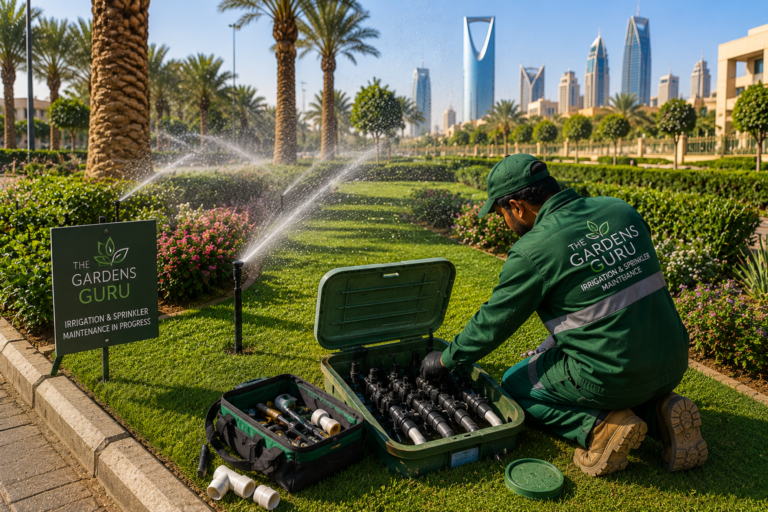
Water Is EverythingIn Riyadh’s climate, irrigation is not optional — it IS your garden’s lifeline. Without consistent, properly designed watering, no plant survives more than a few days in summer. The key is efficiency — delivering maximum hydration with minimum waste.
Drip Irrigation (Best Choice)
- Delivers water directly to roots — zero splash waste
- Uses 40–60% less water than traditional methods
- Ideal for plant beds, trees, and shrubs
- Reduces weed growth between plants
- Minimal evaporation loss even in 45°C heat
Smart Sprinkler Systems
- Best for lawn areas where drip isn’t practical
- Weather-sensor integration adjusts output automatically
- Timer-controlled for early morning watering
- Zone-based delivery matches plant-specific needs
- Can reduce water bills by 30% vs. manual watering
Install smart irrigation controllers with soil moisture sensors. These measure actual ground moisture — not just follow a timer — and only activate when plants truly need water. This single upgrade can save 30–50% on your water bill annually.
📅 Recommended Watering Schedule for Riyadh
| Season | Frequency | Best Time | Duration |
|---|---|---|---|
| ☀️ Summer (Jun–Sep) | Daily | Before 6:00 AM | 20–30 min / zone |
| 🍂 Autumn (Oct–Nov) | 3–4× / week | Early morning | 15–20 min / zone |
| ❄️ Winter (Dec–Feb) | 1–2× / week | Mid-morning | 10–15 min / zone |
| 🌸 Spring (Mar–May) | 3–4× / week | Early morning | 15–25 min / zone |
🌵 2. Choose the Right Plants for Saudi Climate
Plant Selection = SurvivalChoosing the wrong plants is the most expensive mistake Riyadh homeowners make. Beautiful nursery plants from temperate climates die within weeks of being planted in Riyadh’s heat. Smart plant selection eliminates 80% of future maintenance problems before they even start.
| Plant | Type | Water Need | Best Use |
|---|---|---|---|
| Date Palm | Tree | Low | Shade & iconic beauty |
| Ghaf Tree | Native tree | Very Low | Desert landscaping |
| Bougainvillea | Flowering vine | Low | Color on walls & fences |
| Lantana | Ground cover | Very Low | Coverage & vibrant color |
| Bermuda / Paspalum | Lawn grass | Medium | Heat-resistant lawns |
| Aloe Vera / Agave | Succulent | Very Low | Xeriscape beds |
| Jasmine | Flowering vine | Medium | Fragrance & privacy |
| Ficus Nitida | Hedge tree | Medium | Privacy screens |
| Desert Rose | Flowering shrub | Very Low | Ornamental accent |
For every 10 plants in your Riyadh garden, aim for at least 7 to be drought-tolerant or native species. This single approach reduces your water consumption by up to 50% and dramatically lowers replacement costs over time.
🌿 3. Improve Soil Quality Continuously
Feed Your FoundationRiyadh’s sandy soil is essentially mineral particles with no organic life. Water runs through it like a sieve, nutrients don’t bind, and roots struggle to anchor. Soil improvement isn’t a one-time task — it’s an ongoing part of your maintenance routine.
- Add organic compost every 3–4 months to replenish nutrient levels
- Apply balanced NPK fertilizers at the start of each growing season
- Mix soil conditioners to improve water-holding capacity in sandy areas
- Use iron chelate supplements to correct chlorosis from alkaline pH
- Top-dress lawn areas with compost blend annually in spring
- Test soil pH every 6 months — adjust with sulphur if above 8.5
Create a “compost tea” by soaking compost in water for 24 hours and using the liquid to water plants. This delivers nutrients directly to roots in a form that even sandy Riyadh soil can’t wash away immediately — and it’s essentially free.
✂️ 4. Regular Lawn & Plant Maintenance
Consistent Care = Healthy GardenEven with perfect irrigation and the right plants, routine hands-on maintenance is non-negotiable. Plants in Riyadh’s heat grow differently — some grow faster to survive, others slow down to conserve energy. Your maintenance must adapt accordingly.
| Task | Frequency | Why It Matters |
|---|---|---|
| Lawn Mowing | Weekly (summer) / Bi-weekly (winter) | Prevents heat stress, promotes even growth |
| Shrub & Hedge Trimming | Every 2 weeks | Maintains shape, improves air circulation |
| Dead Leaf Removal | Weekly | Prevents pest harborage and disease spread |
| Flower Bed Maintenance | Weekly | Removes spent blooms, encourages new growth |
| Irrigation System Check | Weekly (summer) / Monthly (winter) | Catches leaks, clogs, and pressure issues early |
| Fertilizer Application | Monthly | Replenishes nutrients washed from sandy soil |
| Pest & Disease Inspection | Monthly | Early detection prevents costly plant loss |
☀️ 5. Protect Plants from Extreme Heat
Survival StrategiesRiyadh’s summer heat doesn’t just stress plants — it can kill established trees and shrubs in a matter of days if protection measures aren’t in place. Heat protection is as important as watering itself.
Shade Structures
- Pergolas with climbing plants for natural cooling
- Shade cloth (50–70% density) over sensitive plants
- Strategic tree placement for afternoon shade
- Garden walls that block direct western sun exposure
Timing & Technique
- Water before 6:00 AM — never in afternoon heat
- Apply thick mulch layer (8–10cm in summer)
- Avoid pruning during peak heat months (July–August)
- Move container plants to shaded areas in summer
Never water your garden between 10 AM and 5 PM in summer. Water droplets on leaves act as magnifying glasses under intense sun, causing burn spots. Water evaporates before reaching roots. Always water at dawn — it’s the single most important timing rule for Riyadh gardens.
🌊 6. Use Mulching for Water Retention
Your Garden’s Best FriendMulching is arguably the single most cost-effective maintenance technique for Riyadh gardens. A proper mulch layer transforms your soil’s ability to retain moisture, regulate temperature, and suppress weeds — all with minimal effort.
- Reduces surface evaporation by up to 70% in peak heat
- Keeps soil temperature 10–15°C cooler than exposed ground
- Suppresses weed growth by blocking sunlight to weed seeds
- Slowly decomposes, adding organic matter back into sandy soil
- Protects roots from temperature shock during Riyadh’s dramatic day-night swings
- Creates a cleaner, more professional garden appearance
Organic Mulch
Wood chips, bark, shredded leaves. Breaks down to feed soil. Reapply every 3–4 months.
Gravel / Stone Mulch
Permanent, heat-reflective. Ideal for xeriscape and desert beds. No replacement needed.
Straw / Hay Mulch
Budget-friendly, great water retention. Best for vegetable gardens and seasonal beds.
Need Professional Garden Maintenance in Riyadh?
Our expert team handles everything — irrigation management, plant care, soil improvement, and seasonal protection — so your garden thrives year-round without the stress.
🛠️ 7. Seasonal Garden Care Calendar for Riyadh
Year-Round StrategyRiyadh’s seasons demand completely different maintenance approaches. What works in winter will damage your garden in summer. Following a seasonal care calendar is essential for keeping your landscape healthy through the full year.
Summer (June – September)
🌡️ 40–50°C · Survival Mode- Water daily before 6:00 AM — twice if extreme heat
- Apply maximum mulch depth (8–10cm)
- Install shade cloth over vulnerable plants
- Avoid fertilizing in July–August (plant dormancy)
- Monitor irrigation system daily for clogs or failures
- Move container plants to shaded, protected areas
Autumn (October – November)
🌡️ 25–38°C · Recovery Phase- Reduce watering to 3–4 times per week
- Begin fall fertilizer application (NPK balanced)
- Plant new additions — best planting window begins
- Remove dead summer growth and damaged branches
- Refresh mulch layer after summer degradation
- Deep-aerate compacted lawn areas
Winter (December – February)
🌡️ 8–22°C · Growth & Planting- Water only 1–2 times per week
- Focus heavily on soil enrichment and composting
- Major pruning window — shape trees and hedges
- Plant winter flowers (petunias, marigolds, pansies)
- Overseed lawn areas for thick spring growth
- Repair and upgrade irrigation system components
Spring (March – May)
🌡️ 22–40°C · Peak Growth- Increase watering to 3–4 times per week
- Apply spring fertilizer and iron supplements
- Monitor for pest emergence (aphids, whitefly)
- Last window for new planting before summer heat
- Pre-apply mulch before June heat arrives
- Test and calibrate irrigation for summer demand
🌿 8. Lawn Care Tips for Riyadh Gardens
Keeping Grass Alive & GreenMaintaining a green lawn in Riyadh requires specialized grass varieties, precise watering, and consistent care. Most temperate-region grasses fail here completely. Success depends on choosing heat-resistant species and following Riyadh-specific techniques.
- Use only heat-resistant grass — Bermuda, Paspalum, or Seashore Paspalum varieties
- Mow at 5–7cm height — never scalp the lawn in hot months
- Avoid overwatering — soggy soil causes root rot faster than drought kills grass
- Fertilize monthly with nitrogen-rich fertilizer during growing season (Oct–May)
- Aerate lawn twice per year — compacted soil suffocates grass roots
- Overseed bare patches in November for maximum winter recovery
- Apply pre-emergent herbicide in February before weed season
In peak summer, it’s normal for Bermuda grass to go slightly dormant and turn yellowish-green. Don’t panic — and don’t over-water. The grass is conserving energy. It will fully green up once temperatures drop below 38°C. Over-watering dormant grass causes disease.
🧠 9. Smart Landscaping for Easy Maintenance
Design for Less WorkThe smartest maintenance strategy starts at the design stage. A well-designed landscape requires 50–70% less ongoing care than a poorly planned one. If you’re building or renovating your garden, these strategies will save you thousands of riyals every year.
Xeriscape Design
- Uses 60–80% less water than traditional gardens
- Native and drought-adapted plants only
- Gravel, stone, and minimal lawn areas
- Almost zero irrigation needed once established
Zone-Based Design
- Group plants by water needs (hydrozoning)
- Separate lawn zones from plant bed zones
- Hardscape high-traffic areas (no maintenance needed)
- Use raised beds for easier access and better soil control
- Minimize lawn area — replace with gravel, pavers, or ground cover
- Use automated smart irrigation — eliminates manual watering
- Choose slow-growing plants that need less trimming
- Install permanent stone mulch in ornamental beds
- Add hardscaping (pergolas, pathways, seating walls) — zero plant care needed
- Design for natural drainage — reduces standing water and mosquito problems
⚠️ Common Garden Maintenance Mistakes in Riyadh
Avoid These Costly ErrorsThese are the mistakes our team sees most frequently in Riyadh gardens — each one causes significant damage, wasted money, or complete garden failure.
❌ Overwatering Plants and Lawns
The #1 mistake in Riyadh. Homeowners assume more water = better growth. In reality, overwatering causes root rot, fungal disease, and salt buildup in soil that’s far more damaging than occasional under-watering. Use soil moisture sensors — not guesswork.
❌ Planting Non-Desert Species
Tropical, European, and Southeast Asian plants look beautiful in the nursery but die within weeks in Riyadh’s heat. Always choose species proven to survive 45°C+ temperatures and sandy, alkaline soil conditions.
❌ Ignoring Soil Quality Year After Year
Many homeowners prepare soil once during landscaping and never touch it again. In Riyadh, sandy soil loses nutrients and organic matter continuously. Without regular re-amendment, plant health declines steadily over 6–12 months.
❌ Using a Poor or Non-Existent Irrigation System
Manual hose watering is inconsistent, wasteful, and completely inadequate for Riyadh’s climate. Without a properly designed drip or sprinkler system, water either evaporates before reaching roots or pools on the surface causing damage.
❌ Watering in the Afternoon Heat
Watering during peak sun causes water to evaporate before absorption, leads to leaf scorch (droplets magnify sunlight), and wastes up to 60% of water used. Always water before 6:00 AM or after 7:00 PM.
❌ Skipping Mulch Entirely
Exposed soil in Riyadh loses moisture within hours. Without mulch, you’re essentially fighting the desert with one hand tied behind your back. A proper mulch layer is non-negotiable for any successful Riyadh garden.
⭐ Benefits of Professional Garden Maintenance
Why Experts Deliver Better ResultsWhile some basic tasks can be DIY, professional garden maintenance in Riyadh delivers results that are measurably superior — and often more cost-effective long-term than the damage caused by amateur mistakes.
Saves Your Time
- No weekend hours spent in 45°C heat
- Professional crews complete tasks in a fraction of the time
- Scheduled service — you never have to think about it
Ensures Plant Health
- Expert pest and disease identification
- Correct fertilizer types and timing
- Pruning techniques that promote growth, not damage
Better Appearance
- Uniform lawn cutting and clean edges
- Symmetrical hedge and shrub shaping
- Consistent flower bed management
Increases Property Value
- Well-maintained landscapes add 15–25% to property value
- Curb appeal attracts buyers and renters
- Reduced long-term replacement costs
📍 Garden Maintenance Services Across Riyadh
All Major Districts CoveredProfessional garden maintenance services are available across all major Riyadh neighborhoods. Whether you’re in a new villa district or an established compound, expert help is available nearby.
- 📍 Al Nakheel
- 📍 Al Yasmin
- 📍 Al Malqa
- 📍 Al Olaya
- 📍 Al Yarmouk
- 📍 Al Rawdah
- 📍 Al Narjis
- 📍 Al Sahafah
- 📍 Hittin
- 📍 Al Wurud
- 📍 Al Hamra
- 📍 Al Munsiyah
We cover all Riyadh districts and surrounding areas with weekly, bi-weekly, and monthly maintenance plans. Contact our team via WhatsApp with your location — we typically respond within minutes and can schedule a visit within 24–48 hours.
❓ Frequently Asked Questions
Quick AnswersUse efficient drip irrigation systems, choose drought-resistant and native plants, improve sandy soil with regular organic amendments, apply thick mulch for moisture retention, and follow a seasonal care schedule. Professional maintenance ensures all these elements work together consistently for long-term garden health.
In summer (June–September), water daily before 6:00 AM. In spring and autumn, water 3–4 times per week. In winter, reduce to 1–2 times per week. Always adjust based on actual soil moisture — use sensors rather than a fixed schedule for best results.
Desert-adapted species thrive best: Date Palms, Ghaf trees, Bougainvillea, Lantana, Desert Rose, Aloe Vera, Agave, Bermuda/Paspalum grass, Jasmine, and Ficus Nitida. These are heat-tolerant, low-water plants suited to Riyadh’s sandy, alkaline soil conditions. Avoid tropical and temperate-climate plants entirely.
Yes — drip irrigation is the most efficient method for Riyadh gardens. It delivers water directly to plant roots, reducing evaporation loss by 40–60% compared to sprinklers. It also reduces weed growth between plants and allows precise water control for each zone. Combine it with smart controllers and soil moisture sensors for optimal results.
While basic tasks like removing debris are manageable DIY, professional maintenance ensures proper irrigation management, correct fertilization, pest identification, expert pruning, and seasonal adjustments that dramatically extend plant life and garden appearance. In Riyadh’s extreme climate, professional care typically saves money long-term by preventing costly plant replacements.
Basic lawn maintenance starts at SAR 500–1,200/month. Full garden maintenance (irrigation, trimming, fertilizing, pest control) runs SAR 1,200–3,000/month. Premium packages with irrigation monitoring and seasonal care range from SAR 3,000–6,000/month depending on garden size and complexity.
The best planting window is October through March — when temperatures are moderate and plants have time to establish root systems before summer heat arrives. Avoid planting anything new between June and September, as establishment stress combined with extreme heat causes very high failure rates.
Mulch reduces surface evaporation by up to 70%, keeps soil 10–15°C cooler than exposed ground, suppresses weed growth, and slowly decomposes to add organic matter back into nutrient-poor sandy soil. In Riyadh’s climate, mulching is one of the single most impactful and cost-effective maintenance techniques available.
🌟 Keep Your Riyadh Garden Thriving Year-Round
From irrigation management to seasonal care — our expert team handles everything so your garden stays healthy, beautiful, and water-efficient through every season.